Update to the EU list of non-cooperative jurisdictions for tax purposes.
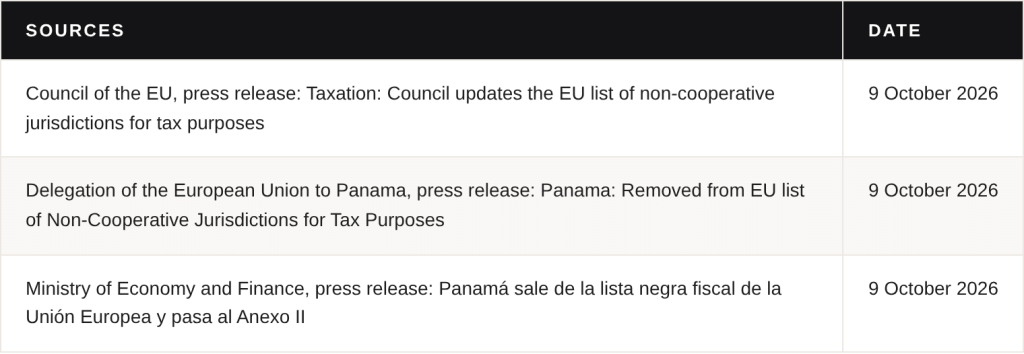
On 9 October 2026, the Council of the European Union (EU) decided to remove Panama from Annex I of the EU list of non-cooperative jurisdictions for tax purposes, known as the “blacklist”. With this decision, Panama is now included in Annex II. Panama had been included in Annex I since February 2020, so the decision ends more than six years of listing. This is a milestone for the country and good news for those doing business with and from Panama.
Why Panama was removed
According to the Council of the EU, Panama has reformed its harmful foreign-source income exemption regime. In addition, the Global Forum of the Organisation for Economic Co-operation and Development (OECD) has granted Panama a new review regarding its compliance with international standards on the exchange of tax information on request. The Council therefore decided to move Panama to Annex II pending that review. The Delegation of the EU to Panama specified that these reforms include the passing, earlier this year, of a law on economic substance and its implementing decree.
What this means in practice
Less friction with European counterparties. According to the Delegation of the EU to Panama, inclusion in Annex I triggers the application of defensive measures by EU Member States, which retain discretion in determining the measures to be imposed. These could include tax and administrative measures, as well as enhanced scrutiny of certain transactions involving the Annex I jurisdiction. The Delegation confirmed that, now that Panama is removed from Annex I, such measures will also be lifted.
A stronger starting point in compliance processes. Leaving the blacklist removes a factor that often came up in due diligence and reputational risk reviews, and may ease conversations with banks, investors and European partners.
A good time to review structures. With the economic substance law now passed, it is a good moment for companies with a presence or structures in Panama to check that their organization, staff and corporate governance are aligned.
What comes next
Annex II, in turn, reflects ongoing EU cooperation with jurisdictions that have committed to reform their legislation to adhere to agreed tax good governance standards. According to Panama’s Ministry of Economy and Finance (MEF), being in Annex II means that the EU considers Panama a cooperative jurisdiction, although with pending commitments on transparency and tax good practices, which the EU will continue to monitor.
Panama has committed to a review by the OECD Global Forum on Tax Transparency and Exchange of Information for Tax Purposes. According to the Delegation of the EU, Panama will be removed from Annex II once the results of the review confirm Panama as largely or fully compliant with the international standards. The Council updates the list twice a year, and the next revision of the list is scheduled for February 2027.
This communication provides a high-level summary and does not constitute legal advice, nor does it create an attorney-client relationship. The application of this decision depends on the circumstances of each company.